

The New Normal: Restaurants of the Future Are Here Now
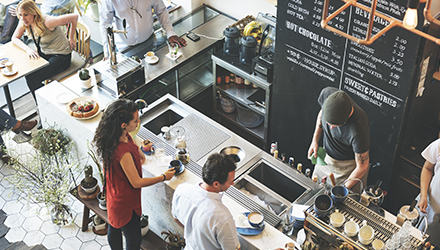
The new normal for restaurants is exponential growth in technology. Franchised restaurant chains have the infrastructure, research and development to bring this to the public first. In order to pay for these advances, expect future consolidation of franchise brands for economies of scale.
Artificial intelligence at Your Local Drive-Thru
Did you know that 80% of quick service restaurant (QSR) orders are generated by drive-thru purchases? That is why we are starting to see the cutting-edge technology of artificial intelligence in order taking. Hamburger chains Checkers and Rally’s have started to implement AI in their corporate drive-thru restaurants. The effort is intended to be invisible to customers except to reduce wait times. The AI works in the kitchen to create food preparation efficiencies. Customers will hear an automatic voice intended to improve order accuracy, increase upsells, reduce kitchen labor costs and improve customer experiences. Many other restaurants are using AI but rarely at the customer interface.
New Consumption and Pricing Trends
Research shows QSR customers and fast-casual customers are willing to spend twice as much at clean and safe restaurants than those that are not meeting brand standards. Look for pricing variability due to inflation. Consumers have expressed an increased willingness to pay for menu items which are fresh and clean, regardless of incremental cost. Consumers react better to menu price increases than increases in delivery fees.
Inflation, now running at 7.9% impacts restaurants in various ways. First we have real estate costs, which may have rents that are CPI adjusted. These costs lag menu pricing but will impact operator profits. Fuel costs are rising even quicker as are labor costs. Technological advances in ovens and labor cost reducing have limitations. You can watch the menu prices increase next year to gauge how the world is coping with crisis.
Restaurant Development
Inflation impacts restaurant development acutely because or increased borrowing costs and construction material costs. Look for new locations to have smaller footprints. Look for “Express” versions of the outlets or “nontraditional” units placed at locations with novel delivery capabilities. Drive-up ghost kitchen pick-ups, placement in apartment building lobbies and central urban settings.
Virtual Food Courts
The new differentiator among competitors will be food temperature and freshness. Food pick-up sites will be honed to maximize retention of food temperature. Companies with fleet infrastructure will have competitive advantages over companies using third-party delivery systems. Brands will share delivery systems by creating virtual food courts with their own delivery fleets to satisfy customer demand for fresh, how and tasty foods. Expect to see more robotic vehicles delivering food orders.
Use of Apps and Websites
Pre-pandemic, 23% of all orders used a restaurant website or app for ordering. Now it is 31% of all orders and approaching drive-thru proportion. Urban, upper income and younger consumer segments use digital ordering more frequently, as expected. Quality-focused customers tend to use restaurant websites and apps more frequently than third-party apps for ordering. This tells us that restaurants need to step up their own websites, apps and delivery systems.
Contactless Ordering Is Here to Stay
Panera Bread has a new feature on its mobile app. It allows consumers to order meals on their own devices for plated, dine-in service. Subscribers to Panera’s loyalty program will receive a notification when they enter to restaurant of this new utility. The customer will be asked to order in order to skip the cashier and order line, and just pick up the plate at the pick-up counter.
Legal Aspects of the Technology
We have software and privacy issues to address in rolling out the chain restaurant of the future in addition to the normal restaurant issues of labor, food safety, health effects, real estate development and intellectual property. Businesses have developed to finance the restaurant technology sector through consolidation of technology companies in this space. New financing models have been developed to sell the IP to outside companies to raise funds for the restaurant chain as an alternative to private equity sales of control. The IP holder leases back the IP and the transaction looks like structured finance except the lender is the owner of the IP leasing it back and participating through royalties of increased development. Lawyers and lenders are now focused on efficient development of restaurant technology and IP sale leasebacks for restaurants, and all branded businesses, for the future.
Reprinted with permission from the March 21, 2022 issue of The Legal Intelligencer© 2022 ALM Media Properties, LLC. Further duplication without permission is prohibited. All rights reserved.