

Inventors' Own Words Narrow Claims in DNJ Pharmaceutical Patent Dispute

Key Points
- Statements made during patent prosecution can narrow claim scope under the prosecution disclaimer doctrine.
- A clear and unmistakable disavowal in inventor declarations overrides the patent specification.
- Expert testimony gets no weight in claim construction when the intrinsic record is unambiguous.
What a patent applicant says to win allowance can define a claim more decisively than the patent's own definitions.
In a recent claim construction opinion, U.S. District Judge Stanley R. Chesler of the District of New Jersey held that a “clear and unmistakable” prosecution disclaimer foreclosed a litigant’s proposed claim construction. The Court’s thorough analysis provides a timely reminder for all patent litigators of the importance of reviewing a patent’s prosecution history in depth and presenting relevant context to the Court for its analysis.
Although patent litigation shares many elements with other litigation, the claim construction process through which the Court determines the meaning of the asserted claims is unique. This deceptively simple-sounding process can be anything but straightforward. In some cases, the Court’s construction of disputed claim terms may effectively resolve the issues of infringement and validity. The Court’s construction of claim terms is therefore a critical moment in any patent litigation.
Background
Plaintiffs Jazz Pharmaceuticals, Inc. and Gentium S.R.L. (collectively, “plaintiffs”) asserted claims from U.S. Patent Nos. 11,085,043 (“the ’043 patent”), 11,236,328 (“the ’328 patent”), 11,746,348 (“the ’348 patent”), 12,529,052 (“the ’052 patent”), and 12,534,722 (“the ’722 patent”) against defendants Almaject, Inc., Alvogen, Inc., and Alvogen PB Research & Development LLC (collectively, “defendants”). The parties disputed the meaning of two claim terms, “defibrotide” and “consisting of,” with the majority of the opinion focusing on the former, which appears in every claim in every patent at issue.
The Court summarized the parties’ dueling constructions as follows: plaintiffs proposed that “defibrotide” means “a substance of natural origin which is obtained by extraction from animal organs and which is constituted by the sodium salt of polydeoxyribonucleotides having a low molecular weight”; defendants proposed that defibrotide means “defibrotide containing less than 10% double stranded DNA.” Because the patents all share a common specification, the Court and the parties focused on the ’043 patent as representative for claim construction.
The Court’s Analysis
Claim Construction and Prosecution Disclaimer
The Court began its analysis by reviewing well-established Federal Circuit precedent governing claim construction: “the words of a claim are generally given their ordinary and customary meaning,” which is “the meaning that the term would have to a person of ordinary skill in the art in question at the time of the invention, i.e., as of the effective filing date of the patent application.” The Court reiterated that it looks to the claims, specification, prosecution history, and extrinsic evidence to construe the claims.
Relevant to the dispute, the doctrine of prosecution disclaimer “precludes patentees from recapturing through claim interpretation specific meanings disclaimed during prosecution.” The disclaimer must be clear and unmistakable for the doctrine to apply. If, on the other hand, “the alleged disavowal is ambiguous, or even amenable to multiple reasonable interpretations,” the Court will not find prosecution disclaimer.
The Dispute
After receiving a non-final office action rejection during prosecution of the ’043 patent, the applicants submitted two inventor declarations and remarks arguing the examiner-cited prior art (particularly a reference called Fedeli) did not render the proposed claims obvious. The parties agreed that “1) Fedeli taught that defibrotide compositions having below 10% double stranded DNA will be inactive; and 2) the applicants demonstrated that their inventive defibrotide formulations unexpectedly maintained potency, contrary to the teachings of Fedeli.” However, defendants argued the inventor declarations amounted to a clear and unmistakable disclaimer of compositions with greater than or equal to 10% double stranded DNA.
In particular, Defendants pointed to inventor declarations stating that:
6. Fedeli teaches defibrotide compositions that have an amount of double stranded DNA (i.e. heterochromicity) between about 10% and 20%. See column 2, lines 32-33. Importantly, Fedeli teaches that defibrotide compositions having below 10% double stranded DNA will be inactive. See column 3, lines 9-16. Fedeli teaches that pharmacologically active defibrotide compositions for therapeutic uses must have about 15% double stranded DNA. Id.
7. In contrast, as explained below, the defibrotide in the compositions taught in this application contain less than 10% double stranded DNA, which according to Fedeli should render the compositions inactive. Yet these defibrotide compositions are biologically active.
Defendants argued that the inventors’ statements to the USPTO that their defibrotide compositions having less than 10% double stranded DNA differentiated those compositions from the cited prior art necessarily narrowed the scope of the applicants’ patent claims, along with additional remarks made by the applicants.
In response, plaintiffs pointed to a definition of “defibrotide” found in the specification of the patent: “Defibrotide (Merck Index, 1996, no. 2915) is a substance of natural origin which is obtained by extraction from animal organs and which is constituted by the sodium salt of polydeoxyribonucleotides having a low molecular weight.” Plaintiffs further argued that the applicants’ statements made during prosecution did not rise to the level of “clear and unmistakable disavowal” required to find prosecution disclaimer.
Plaintiffs also argued that the prosecution history supported that defibrotide included compositions with both less than 10% double stranded DNA and greater than or equal to 10% double stranded DNA. Central to this dispute was an inventor declaration and the significance of highlights made therein to a table reporting activity of batches with less than 10% double stranded DNA, and other batches with greater than or equal to 10% double stranded DNA.
The Court discussed this at length. The inventor declaration contained a paragraph of text above a highlighted table:
10. Moreover, the present defibrotide compositions have demonstrated biological activities that Fedeli teaches are not possible. The specification of the present ‘541 appliction [sic] demonstrates the biological activity of many of the same batches we tested. Table 4 from the specification is reproduced below with the relevant batches highlighted. All of these highlighted batches contain less than 10% double stranded DNA and demonstrate a biological activity (IU/mg) between 31 and 35.
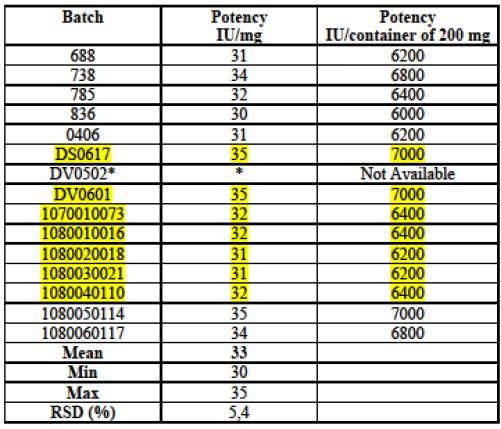
This table was also reproduced in the specification without any highlighting.
The Court observed that although plaintiffs’ brief presented the table with highlighting, it omitted the explanatory paragraph found in the inventor declaration. The Court disagreed with plaintiffs’ argument that “Nothing in the April 15 Declaration . . . would have informed a POSA that these batches were not covered by the claims” because “the first sentence of paragraph 10 in the Declaration states: ‘the present defibrotide compositions have demonstrated biological activities that Fedeli teaches are not possible.’”
The Court analyzed the inventor declaration, holding “[t]he applicants have established that they are distinguishing two groups of defibrotide formulations: 1) the first is the group of defibrotide compositions covered by the Fedeli patent; and 2) the second is the group of defibrotide compositions covered by the claims in the application the applicants were prosecuting, for which the Inventor Declaration was submitted. Thus, the reader has a foundation to understand that, in the first sentence in paragraph 10, referring to ‘the present defibrotide compositions,’ the Inventors mean the second group, the defibrotide compositions covered by the claims in the application presently being prosecuted.”
Accordingly, the Court held that “the Inventor Declaration, read as a whole, and in particular paragraph 10, clearly and unmistakably inform a POSA that defibrotide formulations below the 10% double stranded DNA line are included in the group of the ‘present defibrotide compositions,’ and that defibrotide formulations at or above the 10% double stranded DNA line, the batches not highlighted in the paragraph 10 table, are not included in the group of the ‘present defibrotide compositions. ’” (emphases in original).
The Court also addressed the fact that plaintiffs provided unrebutted expert testimony supporting theirs interpretation of the inventor declaration, finding the proffered expert declaration to be extrinsic evidence the Court was not required to consider. The Court relied on Federal Circuit precedent holding that although expert testimony may be appropriate, it “may not be used to diverge significantly from the intrinsic record…Accordingly, the intrinsic record “must be considered and where clear must be followed.” The Court parenthetically cited Vitronics Corp. v. Conceptronic, Inc., 90 F.3d 1576, 1584 (Fed. Cir. 1996) for the proposition that where “the patent documents are unambiguous, expert testimony regarding the meaning of a claim is entitled to no weight.”
The Court found “remarkably apt” the defendants’ citation to a non-published Federal Circuit decision holding “[w]here, as here, an analysis of the intrinsic evidence alone will resolve any ambiguity in [the] disputed claim term it is improper to rely on extrinsic evidence, such as expert testimony, to introduce ambiguity.” The Court additionally discussed in a footnote that plaintiffs’ expert declaration is “unhelpful for the purpose of claim construction, as well as inadmissible under F.R.E. 702(a), because it does not help the trier of fact to understand an issue.” In part, the Court observed that the expert “does not show awareness that the legal question here is what a POSA would understand about what the applicants communicated to the USPTO about claim scope in order to overcome the obviousness rejection and obtain their patent.”
The Court summed up its view of “the table, which appears in the specification without highlighting and in the Inventor Declaration with highlighting, as a visual expression of the surrender of claim scope that occurred during prosecution.” The Court further rejected plaintiffs’ argument that the inventors’ declarations were subject to multiple reasonable interpretations, holding “[t]his Court has found only one reasonable interpretation of the relevant statements in the prosecution history, and it is the interpretation proposed by Almaject.”
Finally, the Court rejected plaintiffs’ assertion that because defendants submitted no expert declaration, their expert’s “conclusions remain unchallenged.” The Court reiterated it had “found the relevant statements in the prosecution to be clear and unmistakable; the patent documents are unambiguous, and Dr. Stein’s Declaration is entitled to no weight.”
The Court further found that plaintiffs had provided “no support” for their assertion that defendants’ proposed construction “seeks to read several preferred embodiments out of the claim.” The Court found it “misleading” to say that defendants’ proposed construction excludes embodiments; “it is more accurate to say that the applicants narrowed the scope of the claims during prosecution and therefore surrendered coverage of some compositions that had previously been within the scope of the claims.”
The Court concluded that “the applicants for the ‘043 patent unequivocally disavowed a certain meaning of ‘“defibrotide‘ to obtain their patent,” adopting defendants’ proposed construction of “defibrotide” as “defibrotide containing less than 10% double stranded DNA.”
In addressing the second disputed claim term, the parties agreed that “consisting of” had its ordinary meaning. However, defendants proposed ordinary meaning plus the addition of “e.g.” clauses for different patents. The Court rejected this, asking “[i]f the ordinary patent law meaning is so clear, what need is there for adding in a confusing system of varying examples?”
The Court thus found that the ordinary meaning of the phrase applied, which the Federal Circuit has construed as closed to unrecited elements.
Takeaways
This decision matters because claim construction is often the turning point in patent litigation, and the construction of a single term can effectively decide infringement and validity. Here, the applicants had overcome an obviousness rejection over the Fedeli reference by distinguishing their defibrotide by its double-stranded DNA content. Years later, Jazz argued that the patent's broad definition still controlled. The Court disagreed, holding that the applicants "clearly and unmistakably surrendered" the broader scope and that the surrendered subject matter "cannot be recaptured in patent litigation.”
The opinion is equally pointed about extrinsic evidence. Jazz offered an unrebutted expert declaration to suggest the prosecution record was ambiguous. The Court found no ambiguity to resolve, held that reliance on the declaration would be improper, and gave it no weight.
For practitioners, the lesson has two parts. Prosecution counsel should choose distinguishing arguments knowing they may permanently fix claim scope. Litigators should comb the full prosecution record, including its context, before building a construction around the specification alone.
Paul W. Kalish and Jonathan J. Madara are members of the IP Litigation team in Fox Rothschild’s Princeton, NJ office and write about patent litigation decisions in the District of New Jersey. Contact Paul at pkalish@foxrothschild.com or 609.895.6751 and Jonathan at jmadara@foxrothschild.com or 609.844.7428.
This information is intended to inform firm clients and friends about legal developments, including the decisions of courts and administrative bodies. Nothing in this alert should be construed as legal advice or a legal opinion. Readers should not act upon the information contained in this alert without seeking the advice of legal counsel. Views expressed are those of the authors and not necessarily this law firm or its clients.